 EN

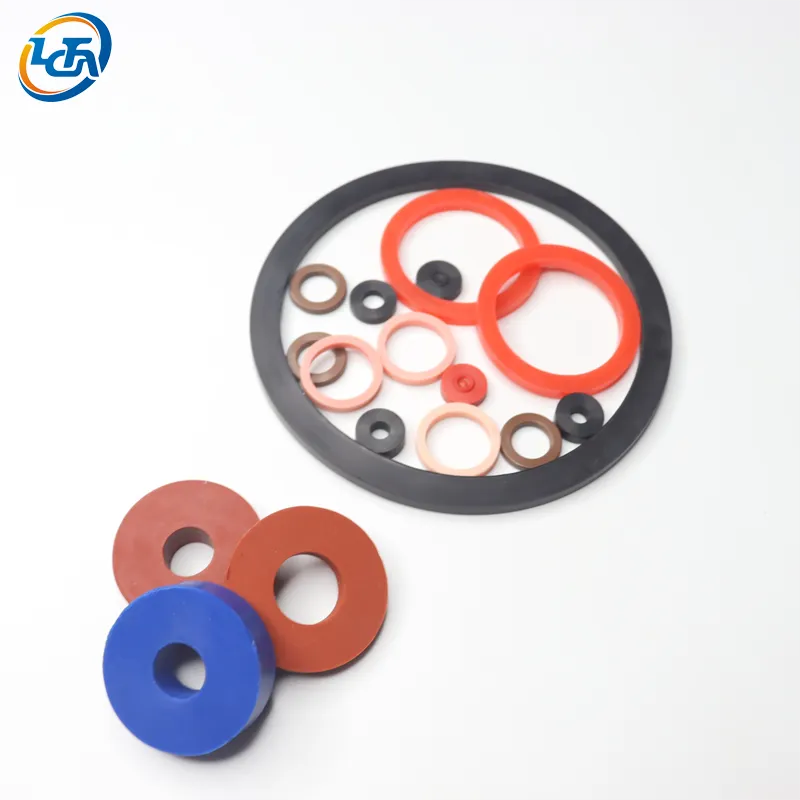
What a Rubber Washer Actually Seals
A rubber washer is usually drawn as a flat ring under a bolt, and that simple picture hides what it is really doing. In a sealing position, the rubber washer is not sealing the joint face between two components; it is sealing the hole through which the fastener passes. Water, oil, or air reaches the inside of an enclosure by travelling along the bolt, through the clearance between the fastener and the panel, and out under the head. The rubber washer closes that path by being compressed between the fastener head and the panel, so the leak route is blocked at its narrowest point. Understanding this changes how the part is specified, because the dimensions that matter are the ones that control compression around the hole, not the ones that control appearance.
Compression Is the Seal, Not the Rubber
A rubber washer does not seal because the material is rubber. It seals because it is squeezed, and being squeezed it pushes back against the fastener head and the panel, creating contact pressure around the hole. That contact pressure has to stay higher than the pressure of the fluid trying to escape, or the fluid will find a path through a micro-channel at the surface. This is why the thickness of the rubber washer matters as much as its diameter: thickness sets how much compression is available for a given bolt travel. It is also why a rubber washer that looks correct but is too thin will leak on a rough panel, while one that is too thick may prevent the fastener from reaching its intended torque. Compression, not material alone, is the sealing mechanism.
Bolt Load, Creep and Why Washers Loosen
Rubber is viscoelastic, which means it continues to deform slowly under a sustained load. In a sealing rubber washer this shows up as creep: the rubber washer gradually thins under the bolt, contact pressure falls, and the joint begins to weep. This is the mechanism behind many "the washer failed" complaints, and it is a property of the material rather than a defect in a particular batch. Harder compounds creep less but conform less to an uneven surface; softer compounds seal better at low load but take a set sooner. That trade-off is the reason the correct hardness depends on the bolt load and the surface finish rather than on a single preferred value. Where a joint must stay sealed for years, it is worth asking whether re-torque is part of the maintenance plan, because the rubber washer will relax and the bolt load will follow.
Matching Material to the Fluid
Material choice follows the same logic used for any seal. Nitrile, or NBR, resists oil, fuel, and grease across roughly -30 to 100 degrees Celsius and is the standard choice for oil-wet fasteners and hydraulic covers. EPDM handles water, steam, ozone, and weather but swells in petroleum oils, which makes it suitable for outdoor panels and washdown areas rather than fuel lines. Silicone, or VMQ, covers roughly -60 to 200 degrees Celsius and is a good electrical insulator, so it suits wide temperature swings and fasteners that must be isolated from a conductive panel, but it is a poor choice for oil contact. Fluororubber, FKM, extends to about -20 to 200 degrees Celsius with strong chemical resistance for aggressive media. Hardness is quoted in Shore A and standard production covers roughly 30 to 90 Shore A, which is enough range to seal a rough casting or resist extrusion under a tight bolt.
Washer, Gasket or O-Ring: Which One Seals the Hole
These three parts are often confused because they all appear around a joint. A rubber washer seals under a fastener and is compressed along the bolt axis. A gasket seals the joint face between two components and is compressed over a much larger area. An O-ring seals in a groove and is retained by the geometry of that groove rather than by the fastener. Using one in place of another is a common source of repeat leaks: a gasket will not seal a bolt hole because it does not sit under the head, and an O-ring will not stay in place under a flat washer unless a groove exists to hold it. Where a joint needs both a face seal and a fastener seal, both parts are required, and expecting one to do both jobs usually ends in a leak that is hard to trace.
A Leak Scenario at a Tank Flange
Consider a tank cover that leaked along the bolt line after a pump was installed nearby. The cover had a gasket around its perimeter, and the leak was initially blamed on the gasket. Tracing the water showed it entering at the bolt heads rather than the cover edge: the fasteners had plain metal washers, and vibration from the new pump had gradually loosened them. Replacing the metal washers with rubber washers sized to the bolt and the hole, at a hardness that compressed against the cover without extruding, stopped the ingress and also damped the vibration that had loosened the bolts. The gasket had been doing its job all along. The leak came from a path nobody had considered, which is typical of fastener-line leaks.
A Specification Checklist for Sealing Washers
Record the fastener diameter, the clearance hole diameter, the required outer diameter, and the thickness. State the bolt load or torque if it is known, the surface finish of the panel, the working and peak temperature, and the fluid the rubber washer will meet. Confirm whether the rubber washer must also insulate or damp vibration, because that changes both material and hardness. Provide a drawing or a sample with measured dimensions, and mark which dimensions are functional. Ask which compound is proposed and confirm the hardness against the bolt load rather than accepting a default. For repeat orders, confirm that the same grade and hardness will be used in every batch, since a change alters both compression and creep behaviour and can turn a sealed joint into a weeping one.
Questions Buyers Ask About Rubber Washers
Does a rubber washer seal better than a metal washer with a rubber insert? It depends on the joint. A bonded washer gives a defined metal bearing surface plus a rubber sealing face and is often easier to torque consistently, while a plain rubber washer is more compliant and better at damping. Both seal the hole; the choice follows the load and the surface. Why does a rubber washer leak after a few months when it did not leak at first? The usual cause is creep. Rubber continues to thin under sustained bolt load, so contact pressure falls over time. A harder compound, a thicker washer, or a planned re-torque usually resolves it. Can a rubber washer be reused after disassembly? It is not advisable. Once compressed, the rubber washer has taken a set and will not return to its original thickness, so contact pressure on reassembly will be lower. Replacing the rubber washer is cheaper than tracing a leak later.
Table of Contents
- What a Rubber Washer Actually Seals
- Compression Is the Seal, Not the Rubber
- Bolt Load, Creep and Why Washers Loosen
- Matching Material to the Fluid
- Washer, Gasket or O-Ring: Which One Seals the Hole
- A Leak Scenario at a Tank Flange
- A Specification Checklist for Sealing Washers
- Questions Buyers Ask About Rubber Washers


