 EN

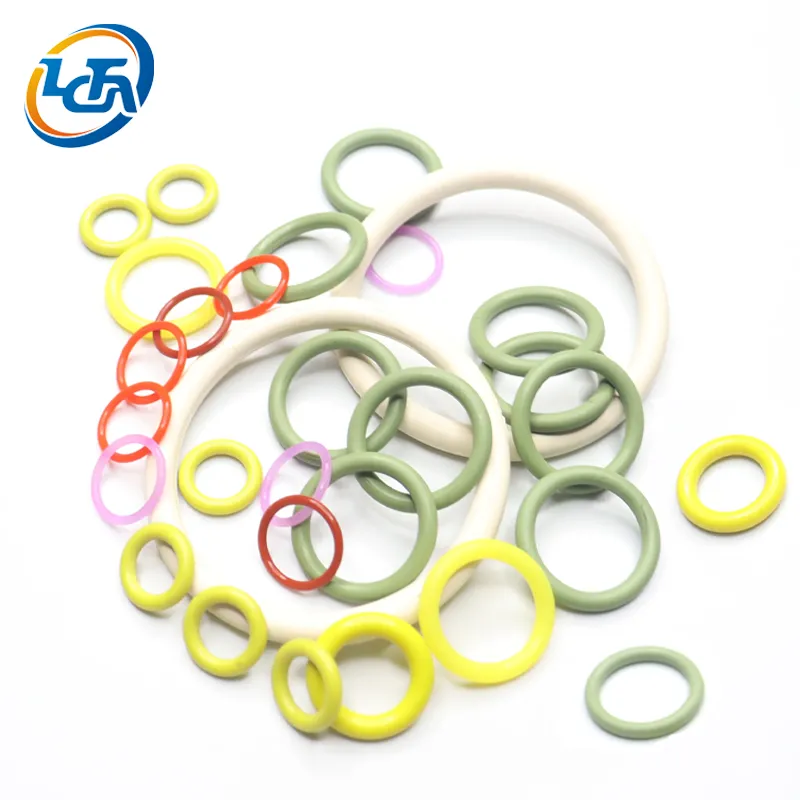
What a Rubber Ring Gasket Is
A rubber ring gasket is a circular sealing element made from rubber, sized to fit a specific groove, flange, or bore and shaped as a ring so it can seal around a passage. It differs from a flat sheet gasket, which is cut to a shape and compressed between two mating faces, and from a simple O-ring, which uses a round cross-section squeezed in a rectangular groove. In practice, the term covers a family of ring-shaped seals, including the O-ring and the ring gasket used on pumps, valves, pipework, and housings. Whatever the exact shape, the working principle is the same: the elastic ring is compressed so that it presses against the sealing surfaces, and that contact pressure blocks the passage of fluid or gas. Because the material is elastic, the ring can follow small changes in the gap and keep sealing as pressures and temperatures move.
How a Rubber Ring Gasket Seals
A rubber ring gasket does not seal by being tight against the metal in a purely mechanical sense. It seals because it is squeezed, and being squeezed it pushes back outward, creating contact pressure at the sealing surfaces. That pressure must stay higher than the pressure of the fluid being contained, or the fluid will find a path past the ring. This is why the amount of squeeze, often called compression, is one of the most important design numbers. Too little squeeze and the ring leaks; too much and the ring may be damaged or take a permanent set that stops it recovering. In a dynamic application, where one surface moves, the ring must also keep contact while sliding, which places extra demand on friction and wear resistance.
Radial Contact and Face Contact
Ring seals work in one of two directions. In a radial seal, the ring is compressed between an inner bore and an outer shaft, so the sealing contact faces inward and outward. This is typical of pistons, rods, and rotating shafts, and it is the mode used by O-rings and X-rings in hydraulic and pneumatic components. In a face seal, the ring is compressed between two flat faces, so the contact faces up and down along the axis. This is typical of flanges, covers, and housings, and it is close in behaviour to a flat gasket. Knowing which mode applies tells the buyer which dimensions matter most, because a radial seal is controlled by bore and shaft size, while a face seal is controlled by groove depth and face flatness.
Groove Design, Squeeze, and Fill
The groove that holds the ring is as important as the ring itself. A correctly sized groove leaves the right amount of squeeze and enough free volume for the rubber to move into when it is compressed, without filling the groove completely. If the groove is too shallow, the ring is over-compressed and ages faster. If it is too deep, the ring loses contact pressure and leaks. Groove surface finish also matters, because a rough surface can abrade a dynamic ring. Buyers who are not certain about a groove can provide a drawing in PDF or CAD, a 3D model in IGES or STEP, or a sample, and a supplier with an in-house mold team can often confirm whether the ring chosen will seat correctly before production.
Ring Gasket, Flat Gasket, and O-Ring Compared
These three sealing elements overlap in use but behave differently. A flat gasket is best for low-pressure, face-contact joints with large or irregular mating areas, such as covers and pipe flanges. An O-ring is best for compact radial or face grooves where high pressure and a small footprint are needed. A ring gasket sits between the two and is often used where a circular seal is needed but the cross-section is not a simple round cord. Because each type depends on squeeze, groove size, and material, the correct choice follows the joint geometry and the pressure, not the part name. Where a standard size exists, it shortens lead time, and where it does not, non-standard rubber ring seals are produced to drawing or sample.
A Practical Application Example
Consider a pump housing that leaked at the cover joint after a rebuild. The cover had been sealed with a flat gasket, but the joint was narrow and operated at a pressure the flat gasket could not hold. Replacing it with a correctly sized rubber ring gasket, seated in a proper groove with the right squeeze, stopped the leak. In a second case, an over-compressed O-ring in a valve failed repeatedly because the groove was too shallow, and the rubber took a permanent set. The fix was not a harder material, but a groove that allowed correct compression. Both examples show that a ring seal is a system of ring plus groove plus material, and that changing only one part rarely solves the problem.
How to Specify a Rubber Ring Gasket
A clear specification records the inner diameter, the outer diameter or cross-section, the groove dimensions, the material and grade, the hardness in Shore A, the temperature range, and the media being sealed. Common materials include NBR for oil and fuel, EPDM for water, steam, and weather, FKM for high temperature and chemicals, and silicone (VMQ) for wide temperature ranges and food, medical, and electronic contact. Hardness usually falls between 30 and 90 Shore A. Buyers should ask for the material grade, confirm the quality system such as ISO 9001, and review CE and RoHS documents against their own requirements. Where the joint is critical, a sample part should be checked before mass production, because squeeze and fit are easier to verify on a physical ring than on a drawing.
Questions Buyers Ask About Rubber Ring Gaskets
Is a rubber ring gasket the same as an O-ring?
Not exactly. An O-ring uses a round cross-section in a rectangular groove, while a ring gasket can have a different cross-section shaped for a particular groove or flange. Both are ring-shaped elastic seals and both depend on squeeze to seal.
Why does a rubber ring gasket leak after a rebuild?
The most common causes are an incorrect groove depth that gives too little or too much squeeze, a material that swells in the media, or a damaged sealing surface. Checking groove dimensions and media compatibility first usually identifies the cause.
Can a rubber ring gasket be made to a non-standard size?
Yes. Custom ring gaskets are produced to a 2D drawing, a 3D model, or a physical sample, so an unusual bore or flange size is not a barrier, although new tooling can affect lead time.


