 EN

Why Buyers Need More Than a Catalogue Size
An O-ring looks like a simple ring, but in practice it is a precision component whose performance depends on compound, hardness, cross-section, colour, and dimensional tolerance. When equipment is old, imported, or built to a non-standard housing, a catalogue size often will not fit, and an incorrect oring will leak, extrude, or fail early. That is why industrial buyers increasingly look for manufacturers who offer genuine custom services rather than a fixed stock list. This guide explains what those custom services typically include, how to describe a requirement clearly, and how to judge whether a manufacturer is set up to deliver.
Material Compounding and Selection Support
The first custom service is compound selection. A manufacturer working with a range of elastomers can match the oring to the fluid, temperature, and pressure in the application. Nitrile, or NBR, suits oil and fuel contact across roughly -30 to 100 degrees Celsius. Fluororubber, FKM, extends to about -20 to 200 degrees Celsius with strong chemical resistance. EPDM handles water, steam, and weather, while silicone, or VMQ, stays flexible from about -60 to 200 degrees Celsius and suits food, medical, and electronic contact. SBR, HNBR, and FFKM cover abrasion, hydrogenated service, and extreme chemical duty. Hardness is quoted in Shore A, commonly produced between 30 and 90 Shore A, and colour can be specified to meet a customer requirement. Whether the part is an O-ring in NBR, FKM, EPDM, or silicone, the choice of compound and the mold that forms it are decided together, which is why a manufacturer that develops both in house can advise on a non-standard oring as confidently as on a stock item.
Tooling, Molds, and Non-Standard Dimensions
The second custom service is tooling and dimensional flexibility. Manufacturers that keep an extensive library of existing molds can often match a standard size without new tooling, which shortens lead time and reduces cost. For parts that fall outside standard ranges, non-standard customisation is required, and the manufacturer produces the oring to the buyer drawing or sample. A supplier holding more than ten thousand usable molds can cover a large share of common market demands while still accepting new non-standard work when needed. This combination of standard stock and custom tooling is what allows an oring to be supplied to both maintenance replacement and new design projects.
Drawing Formats, Samples, and Prototyping
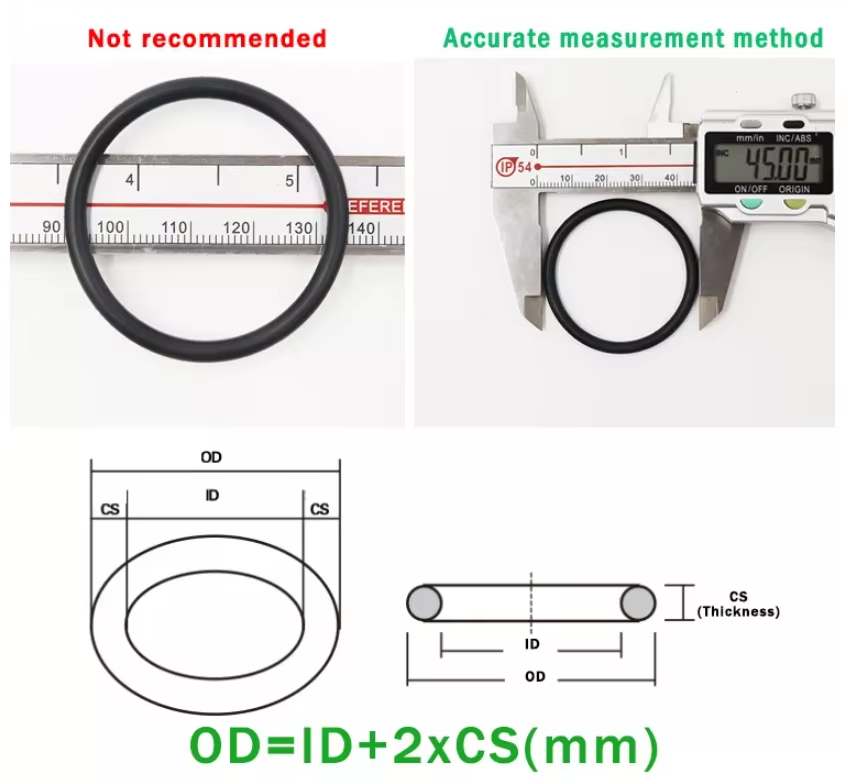
The third custom service is design intake and prototyping. Most manufacturers accept 2D drawings in PDF or CAD and 3D models in IGES or STEP, as well as physical samples. When a drawing is not available, a sample part can be measured and reproduced. Producing a prototype or sample batch before mass production is standard practice, because it lets the buyer confirm fit, hardness, and finish before tooling and volume production are committed. Buyers should always ask whether samples are available and how many iterations are included.
Colour, Hardness, Tolerance, and Quality Documentation
The fourth custom service covers the specification details that influence how a part performs in service. Colour can be matched to a customer requirement, which matters when parts must be identified visually on a production line. Hardness can be adjusted within the Shore A range to balance conformability against extrusion resistance. Dimensional tolerance is agreed against the drawing, and quality checks confirm that the delivered oring meets it. These details are what separate a standard ring from a custom oring that performs reliably in a specific assembly. Because the oring is a sealing element rather than a simple spacer, even a small deviation in cross-section can cause a leak, so tolerance control is treated as part of the custom service rather than an afterthought. A custom oring is only useful if it arrives with evidence that it matches the agreed specification, so buyers should expect dimensional inspection against the drawing, a statement of the material grade and hardness, and confirmation of the quality system the part was produced under. Documentation also supports traceability, which matters when a batch must be linked back to a production run in the event of a field issue. When the application involves regulated sectors, buyers should request the specific test documents their own compliance process requires and confirm that those documents cover the material grade actually purchased. This is normal procurement practice, and a manufacturer that can supply the requested paperwork without delay is easier to audit and to keep on an approved supplier list.
Cost, Lead Time, and Minimum Order Reality
Custom service also affects commercial terms, and buyers should understand the trade-offs before they commit. New tooling adds a one-time cost and lead time, which is why using an existing mold for a standard geometry is often the faster path. Low minimum order quantities make trial production practical, but they can raise the unit cost compared with a large production run. A clear quotation should separate tooling from part price so the buyer can see what is paid once and what is paid per unit. Understanding these three factors, cost, lead time, and minimum order, is what allows a buyer to choose sensibly between a standard stock part and a fully custom oring.
A Practical Sourcing Scenario
Consider a plant maintaining imported machinery where the original oring size is no longer available from the equipment maker. The maintenance team measured the housing and provided a sample ring plus a 3D file. The manufacturer identified a suitable NBR compound for the oil-contact duty, adjusted hardness to resist extrusion under the working pressure, and supplied sample rings for trial fitting. Once the sample passed, production followed against the agreed drawing. The value of the custom service was not only the new size, but the technical conversation about compound and hardness that prevented a repeat failure. When choosing a manufacturer for work like this, ask four questions. Does the manufacturer offer compound advice, or only a stock list? How many molds are available, and how are new non-standard parts handled? Which drawing formats and sample options are accepted? What quality systems and certifications apply, and are the documents available for review? A manufacturer operating to ISO 9001 with CE and RoHS compliance provides a documented baseline. Beyond that, the clearest signal of real custom service is a defined order workflow: product requirement, quotation, confirmed delivery time, proforma invoice, production, shipping, and order completion, with a named contact who answers technical questions.
Questions Buyers Ask About Custom O-Ring Services
Do I need to provide a full drawing to order a custom oring?
Not always. Many manufacturers accept a physical sample or a 3D model, and can produce a drawing for confirmation before tooling.
How many molds does a manufacturer need to cover most sizes?
The useful measure is the usable mold library rather than a raw total. A broad library covering common international standards, such as AS568 and metric sizes, reduces the need for new tooling on standard work.
Is a low minimum order possible for a new custom part?
Many manufacturers offer low minimum order quantities for custom and non-standard parts while maintaining quality, which makes trial runs practical for new projects.
Table of Contents
- Why Buyers Need More Than a Catalogue Size
- Material Compounding and Selection Support
- Tooling, Molds, and Non-Standard Dimensions
- Drawing Formats, Samples, and Prototyping
- Colour, Hardness, Tolerance, and Quality Documentation
- Cost, Lead Time, and Minimum Order Reality
- A Practical Sourcing Scenario
- Questions Buyers Ask About Custom O-Ring Services


